Used vehicle sales · Product Design
Buying a car starts before choosing the model.
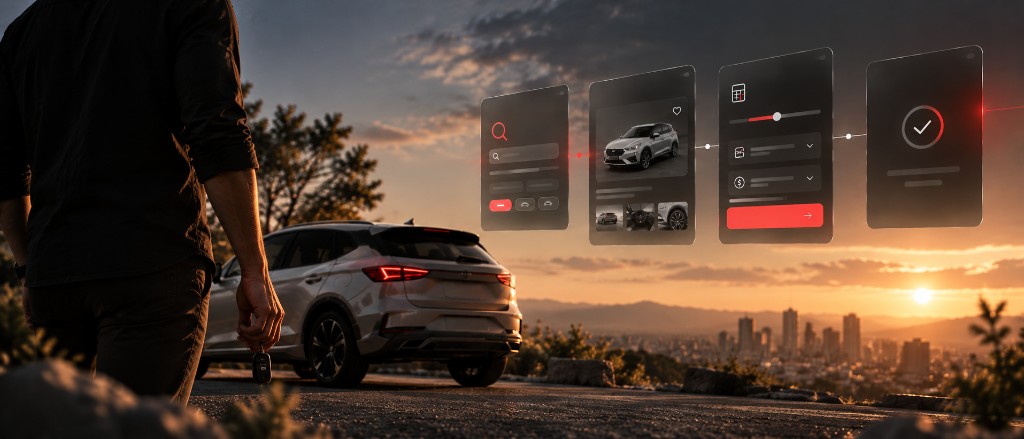
I redesigned the digital vehicle sales experience based on consumer research, commercial opportunities and product decisions that connected discovery, financing and conversion.
Product Designer · End-to-end
Two questions, one decision
Choose+Afford
Purchase decision
Confidentiality note: Under a non-disclosure agreement, customer data, absolute volumes and strategic information have been omitted or generalised. The figures shown were documented during the project.
01Context
Direct sales, from the company to the consumer.
The product is a web and mobile channel for selling the company's used vehicles directly to consumers — people looking to buy a used or nearly new car.
The commercial model made it possible to sell vehicles straight to consumers, without going through the traditional decommissioning process. That opened room for buyers who prioritised price and did not necessarily see decommissioning as a requirement for buying.
Drivers who wanted to buy the car they were already renting helped make this opportunity visible.
- Product
- Direct sales of used vehicles
- Channels
- Web and mobile
- Audience
- Used and nearly new car buyers
- Role
- Product Designer · End-to-end
02The problem
A shop window doesn't make a buying journey.
The previous experience was digitally fragile. Filters didn't work reliably and vehicle photos were repetitive, which made cars hard to assess and undermined consumer trust.
What was on screen
- Filters that didn't work reliably
- Repetitive vehicle photos
What the experience didn't help people do
- 01Discover the vehicles available
- 02Find options that matched their interests
- 03Compare the alternatives
- 04Understand their financing options
- 05Move forward with confidence
Problems identified in the previous experience — not ranked by weight.
When an experience doesn't help people choose,it can also keep them from deciding.
03Discovery
The first question wasn't which screen to build. It was what made someone want — or fail — to buy a car.
I was directly involved in shaping the research plan and analysing the data, together with the Product Owner who coordinated the research. My part included turning what we learned into experience and product opportunities.
Research threads
- Financial reality of consumers and drivers
- Intent to buy a vehicle
- Models and categories of interest
- Influence of credit on the decision
- Financial barriers
- Search behaviour
- Opportunities in the buying experience
Complementary sources of evidence, with different methods and samples.
Study · Credit as a decision lever
Research findings — not results of the new site
Quantitative survey with more than a thousand individual customers, sent by email to a random sample.
- 57%would not have bought a car without credit.
- 48%were strongly or entirely influenced by credit in their final decision.
- 39%named the down payment as one of the main barriers to buying.
Credit wasn't just a financial step.It was part of the decision to buy.
Consumers needed to discover vehicles — but they also needed to understand whether the purchase fit their reality.
04From evidence to opportunity
A car they could buy — not just one they wanted.
The experience had to help people find that car. To do so, the site's structure had to lower the effort of starting a search and connect browsing the catalogue to what each buyer could afford.
- 01FindMake vehicle discovery easier from the very first search.
- 02AssessHelp consumers explore relevant alternatives.
- 03AffordMake financing more accessible throughout the journey.
05Design decisions
Each decision answered a point in the journey.
Working end-to-end, I was responsible for defining practically the entire design experience of the new site.
- Decision 01
Make it easier to start searching
The shop window shouldn't be the only way in. The first screen gave prominence to search and filtering, making it easier to start exploring.
- Decision 02
Guide without restricting
Chips and discovery paths served both people who knew what they wanted and people who needed help getting started — a way to reduce cognitive load and make discovery more accessible.
- Vehicle category
- What it's for
- Price range
- Make or model
- Most searched
- Decision 03
Connect discovery and financing
The financing simulator was given prominence on the Home page. It let consumers move their purchase intent forward without relying only on browsing the shop window.
- Decision 04
Make campaigns visible
A compact strip at the top of the site highlighted campaigns — shown only when one was running.
- Decision 05
One coherent buying experience
Hierarchy, search, filters, the shop window and the financing simulation were designed as parts of one journey, not as isolated components.
Vehicle comparison was explored, but its implementation wasn't confirmed — so it isn't presented here as a feature.
06The experience in use
Less effort to start. More clarity to move forward.
How the new journey works
- 01Home
- 02Discovery and search
- 03Filters and browsing
- 04Vehicle details
- 05Financing simulation
- 06Lead submitted
A conceptual view of the journey on the site. Sales steps after the lead are outside this scope.
The Home page as the way in
From the first visit, the Home page served two needs: discovering vehicles and assessing financing options.
- Discover
- Afford
Home page structure
- Campaign stripOnly when a campaign is running
- Search and filtersFirst screenDiscover
- Discovery chipsDiscover
- Instalment simulatorHighlightedAfford
- Vehicle listingsDiscover
07Validation
The experience had to prove its value beyond the interface.
The analysis compared the new site with the old landing page over about two weeks. During that period, half of the traffic headed to the landing page was sent to the new site and half to the old experience.
+140%in lead volume
New site compared with the old landing page, over the same period.
| Metric | New site | Old landing page | Difference |
|---|---|---|---|
| Lead volume | 2.4× | 1× | +140% |
| Financing applications | ~2.5× | 1× | +148% |
- Absolute volumes omitted for confidentiality — values are relative to the old landing page.
- A traffic-split comparison over a specific period. The full randomisation method wasn't documented.
08The simulator's role
A feature prioritised by research became a key way in.
- Research13 features raised in a survey with more than a thousand respondents.
- PrioritisationThe Home page instalment simulator was among the features prioritised.
- ImplementationSimulator highlighted on the new site's Home page.
- Observed useThe simulator became the main way into leads on the site.
79%of lead entries recorded on the site came through the Home page simulator
Share of lead sources — not a conversion rate, and not evidence that the simulator alone explains the rise in leads.
Home page simulatorOther entries
09Impact
The redesign changed the site's role in the buying process.
- 01AcquisitionThe documented comparison recorded 140% more leads on the new site than on the old landing page during the period analysed.
- 02Financial journeyThe new experience made financing more accessible, connecting vehicle browsing to one of the main barriers identified in the research: the down payment.
- 03DiscoverySearch, filters and chips offered clearer ways to explore the catalogue, including for people who didn't yet know which vehicle to look for.
10Challenge and learning
Knowing what consumers are looking for isn't enough. You have to understand what stops them from buying.
The research showed that the decision to buy didn't depend only on liking a vehicle. Credit, the down payment and clarity about financing options also shaped purchase intent.
Discover.Assess.Afford.
The main lesson was to design for the whole decision — not just the choice of car.